Historical traces: Prepared by: Dr. Laroussi Kamel, Anthropologist, Founder and Head of the Arid Regions Ecomuseum. IRA Medenine.
The Neolithic period (or "Polished Stone Age") in the prehistory of Tunisia appeared only late (4500 to 2000 BC) compared to the Eastern Mediterranean, a period during which climatic changes characterized by drying out have marked Tunisia to the present day.
Historians agree on the classification of the Gaetuli as nomadic Berber peoples inhabiting the south of the Maghreb—near the Numidian and Moorish Berbers of the northern Maghreb (See Map No. 1)—but hesitate to agree on the origin of this population and the various formations that compose it. While some historians classify the Pharusii of southern Morocco and the Garamantes of Fezzan within the Gaetuli group, others refute this hypothesis. According to Camps: "Today's specialists tend to consider that the term Gaetuli actually designated any Libyan leading a nomadic life, and some historians even include the Garamantes among the Gaetuli".
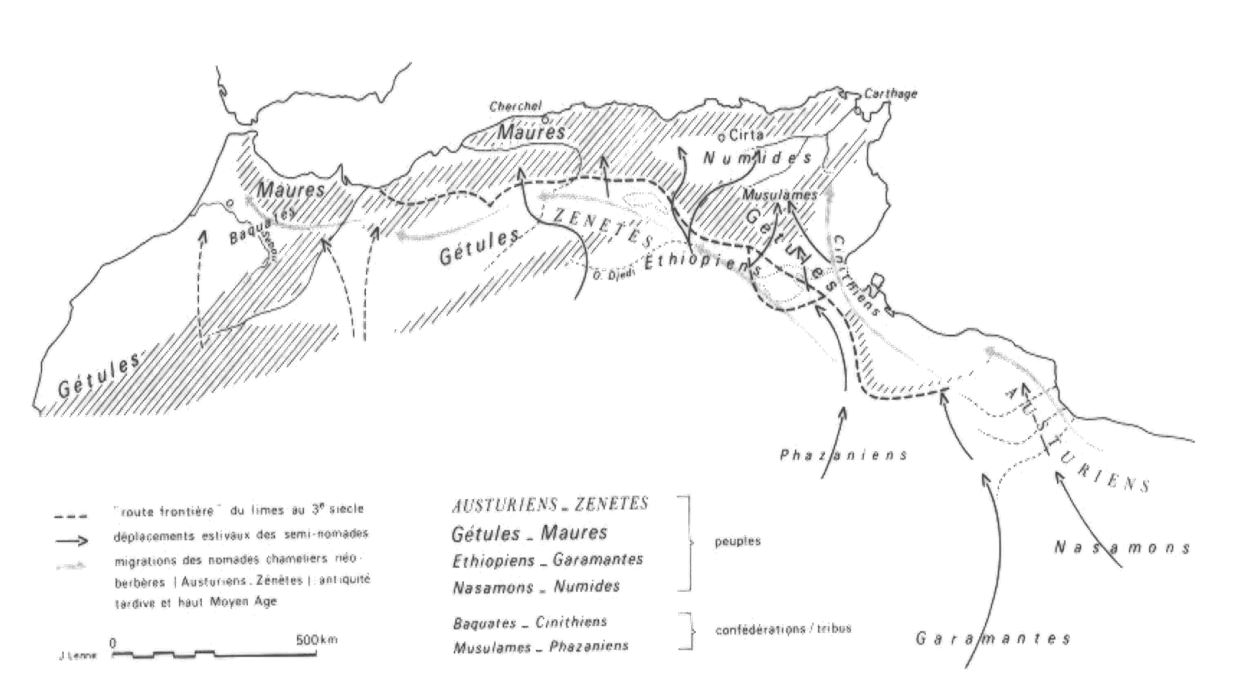 Map No. 1: Main movement axes of nomadic populations across the Roman Limes from antiquity to the early Middle Ages. -after Jean Lenne-

 Photo: ONM