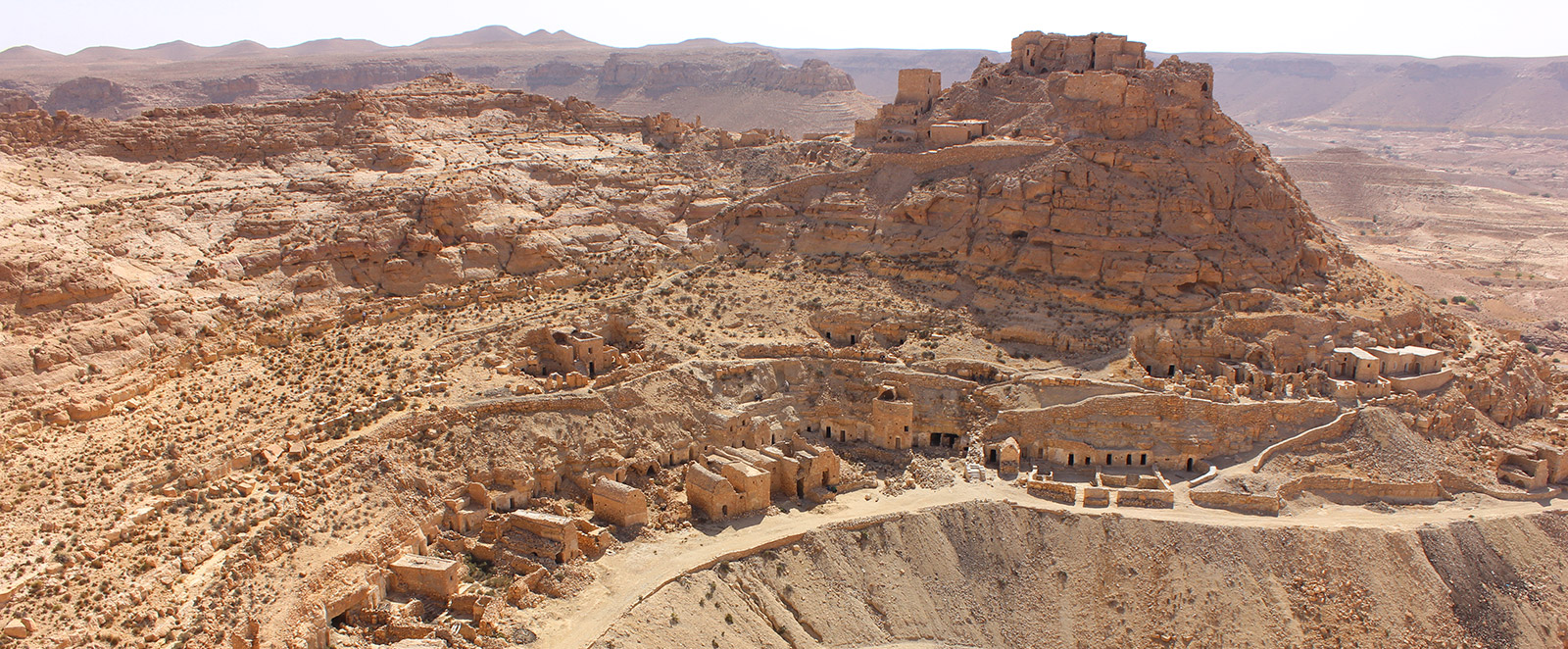
The South-East Tunisian region during the Punic Period
More than 3,000 years ago, the Phoenicians extended their commercial activities to Sicily, North Africa, the European coasts of the Mediterranean, and the Atlantic coasts of Spain. They established anchoring and refueling points, the oldest of which are Gades in Spain (around -1100) and Utica in Tunisia (-1101). Carthage was founded in 814 BC by the Phoenician princess Elissa (Dido to the Romans), who came from Tyre (the city of Sour in Lebanon), fleeing her bloodthirsty brother King Pygmalion.
Until the end of the 6th century, the Carthaginian Empire expanded throughout the Mediterranean basin at the expense of its Greek rivals, who were driven out of their traditional trading posts in the Mediterranean (Sicily, Sardinia, Balearics, Southern Spain, Corsica, and the North African coasts from Tripolitania to the Atlantic).
The defeat of the Carthaginian fleet (commanded by Hamilcar) against the Greeks (commanded by Gelon of Syracuse) following the Battle of Himera (Sicily) in 480 BC eventually re-established Greek control over Mediterranean trade. This new situation forced Carthage—a maritime power—to reposition itself within its African continental environment while seeking other commercial outlets.
Carthage initiated a policy of agricultural development in its hinterland and expanded its trade relations both within the country (Tunisia) and with sub-Saharan Africa and Western Europe (Spain, British Isles).
The voyages of Hanno (450 BC) to tropical Africa and Himilco (5th century BC) to the British Isles in search of precious materials and new markets confirmed this new Carthaginian strategy.
From the 5th century BC, the southern Mediterranean coasts, including those of South-East Tunisia, were dotted with Punic trading posts: Meninx Island (Djerba), Gigthis (Boughrara), Tacapae (Gabès), to ensure the link with trans-Saharan trade (see map). Indeed, the Tripolitanian posts (Gigthis, Lepcis, Oea) served as home ports for the caravan trade maintained by nomads with tropical Africa via Saharan routes.
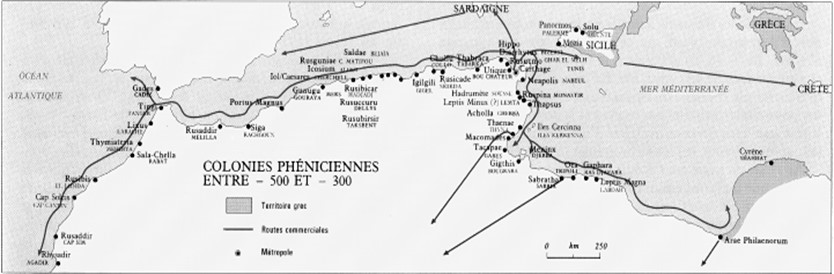 Phoenician colonies between -500 and -300 (Historical Atlas of Africa, op.cit., p. 47)
According to Herodotus, the Garamantes of Fezzan ensured commercial links between Carthage and Sudan, bringing gold, tin, ivory, ostrich feathers, wild animals, and slaves back to the Mediterranean. At that time, the Carthaginian army benefited from these new resources by introducing elephants imported from Africa to equip its troops.
The importance given to the Punic trading posts of the Jeffara plain (South-East Tunisia) increased especially after the loss of Phoenician colonies and posts in Sicily and Sardinia following the first two Punic Wars.
Bibliography
Historical Atlas of Africa / ed. by Catherine Coquery-Vidrovitch and Gorges Laclavère. Paris: Les Éditions du Jaguar, 1988, 174 p; p. 46.
Slim Hédi, Mahjoubi Ammar, Belkhoja Khaled, Ennabli Abdelmajid. Antiquity. Tunis: Sud Éditions, 2003, Volume 1-Series: History of Tunisia, 460 p, p. 79.