GPS Coordinates: N32°57’23’’ E10°28’55’’
Governorate: n.a.
Delegation: n.a.
Site Highlights
-
Observed fall
-
Meteorite origin (Vesta asteroid)
-
Rare diogenite
-
Unusual color
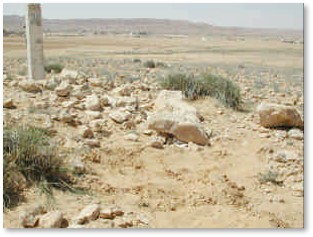
Access route: The meteorite fell northeast of the city of Tataouine, about 500 meters east of the road toward Ben Gardane. To access the site, take the University road. After 200m, turn left onto a track leading to a mesa (butte témoin) at a distance of 2 km.
Site description: This meteorite fell on June 27, 1931, 4 km from the city of Tatahouine; samples were sent to the National Museum of Natural History in Paris.
This meteorite is world-famous for its rarity. Only 15 to 16 kg were recovered, and specimens weighing more than 10 grams are very rare.
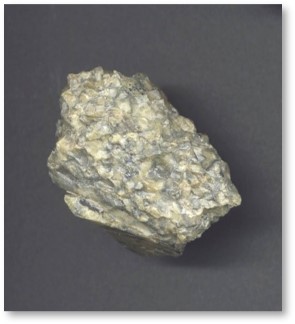 Classification: It is classified among the rare Diogenites, which are part of the calcium-poor Achondrites (meaning they do not contain chondrules). It is mainly composed of magnesium-rich orthopyroxene.
Unusual color: It has a light green to grayish color veined with black.
Probable origin: There is every reason to believe it originates from the Vesta Asteroid, a unique object 500 km in diameter located in the asteroid belt between Mars and Jupiter. Its spectral signature is similar to the very specific one of Vesta.
In 1994, Dr. Alain Carion found documents at the Museum recounting the fall of this meteorite. He immediately went to the site. After a week of searching, he found a few samples. The study of these new samples revealed a chemical evolution of the meteorite, specifically the presence of bacteria, whereas these bacteria did not exist in the 1931 samples. This helped prove the terrestrial origin of other bacteria discovered on a meteorite of Martian origin, ALH84001, which fell 13,000 years ago in Antarctica.